
A Pocket yantra brings a traditional spiritual symbol into everyday life. Instead of remaining on a home altar, a compact yantra can be carried in a wallet, purse, passport holder, or work bag.
The Pocket Numerical Budh (Mercury) Yantra by aDvaar is designed as a portable yantra associated with Budh, or Mercury, in Vedic astrology. Its numerical matrix design distinguishes it from yantras that use primarily geometric forms such as triangles, circles, and lotus petals.

To understand this product, it helps to explore the traditional significance of Budh, the meaning of numerical yantra designs, the role of copper in Indian ritual traditions, and practical ways to incorporate a pocket yantra into a personal spiritual routine.
What Is a Budh Yantra and Why Does It Exist?
A yantra is a diagram used in Hindu spiritual traditions as a focus for worship, meditation, and ritual practice. The aDvaar Knowledge Hub guide to yantras provides a broader introduction to their meaning and traditional uses.
A Budh Yantra is associated with Budh, the Sanskrit name for Mercury in Jyotish astrology. Within this tradition, Budh is connected with intellect (buddhi), speech, communication, learning, commerce, reasoning, and adaptability.
People who follow Vedic astrology may use a Budh Yantra as a devotional focus when reflecting on these qualities or when incorporating Mercury-related worship into their routine. Some practitioners also associate it with Budh Mahadasha, a planetary period that lasts 17 years in the Vimshottari Dasha system.
The yantra should be understood as a spiritual object associated with a particular tradition. There is no established scientific evidence that carrying it changes planetary influences or guarantees improvements in intelligence, communication, business, or financial results.
The Mantra Behind the Yantra: Om Budhaya Namah
A mantra commonly associated with Budh worship is:
Om Budhaya Namah
Another mantra used in some Budh practices is:
Om Braam Breem Broum Sah Budhaya Namah
Mantra wording and transliteration can vary across sources and lineages. Verify the exact wording with a trusted traditional source or the product's current instructions before using it in a formal ritual.
A simple personal practice may involve sitting quietly, placing the yantra in front of you, and repeating a chosen mantra a manageable number of times. Some practitioners use 11 or 108 repetitions. These numbers are customary in many devotional routines, not guarantees of a particular outcome.
Geometric Yantra vs. Numerical Matrix Yantra
Yantras can use different design approaches. Some feature geometric forms such as triangles, circles, squares, and lotus petals. Others use a numerical grid in which numbers occupy particular positions.
A numerical matrix yantra is sometimes described as a magic square when its rows, columns, and diagonals follow a defined mathematical relationship. The exact properties depend on the numbers and arrangement used in the particular design.
A numerical design is therefore not necessarily a simplified version of a geometric yantra. It represents a different visual approach within the wider practice of sacred diagrams. Claims that a specific matrix follows traditional rules should be supported by the design reference or documentation used to create it.
Why Budh (Mercury) Matters in Vedic Astrology
Budh is one of the Navagrahas, the nine planetary influences in Hindu astrology. In Jyotish, Mercury is traditionally associated with intellect, language, reasoning, education, commerce, calculation, wit, and adaptability.
Budh rules Gemini (Mithuna) and Virgo (Kanya) in the traditional astrological system. Mercury is considered exalted in Virgo and debilitated in Pisces. Wednesday, known as Budhvar, is traditionally associated with Mercury, and Lord Vishnu is connected with Budh in several Hindu astrological traditions.
These are astrological associations rather than scientifically established descriptions of personality or ability.
Budh as the Karaka of Intellect and Communication
The Sanskrit term buddhi refers to intellect, discernment, or the capacity to understand and judge. In Jyotish, the association between Budh and buddhi makes Mercury relevant to themes such as speech, writing, mathematics, trade, negotiation, and analytical thinking.
People who follow this tradition may use Budh worship as a reminder to cultivate thoughtful communication, careful reasoning, learning, and adaptability.
When Budh Is Considered Weak in a Horoscope
Some Jyotish practitioners interpret certain planetary placements or aspects as challenging for Budh. Within this framework, such placements may be associated symbolically with difficulties in communication, learning, decision-making, or commerce.
These interpretations are part of a traditional astrological framework, not a clinical or psychological assessment. Concentration problems, anxiety, learning difficulties, or other health concerns should not be diagnosed or treated through astrology or yantra use.
A Budh Yantra may still be meaningful to someone who wants a visual focus for prayer, reflection, or a consistent personal practice.
What Makes the Numerical Matrix Design Different?
The Pocket Budh Yantra is described as featuring a numerical matrix design. Before publishing detailed claims about the exact number sequence or its traditional origin, confirm the product's design and supporting documentation.
How a Numerical Matrix Works
In a mathematical magic square, numbers are arranged so that selected sums—often the sums of rows, columns, and diagonals—are equal. Not every numerical grid is a magic square, so the actual pattern must be checked before describing it that way.
Within spiritual traditions, numerical arrangements may also be assigned symbolic meanings related to a deity or planetary influence. Those meanings should be distinguished from the mathematical properties that can be independently calculated.
Why Numbers, Not Just Lines, Matter
A numerical yantra gives the viewer a structured pattern to observe. Some people may find the numbers and their arrangement useful as a focus for concentration, prayer, or reflection.
Traditional interpretations may attribute spiritual significance to particular numbers and arrangements. However, mathematical symmetry by itself does not establish that a diagram transmits planetary energy or produces measurable effects.
For the Pocket Budh Yantra, claims that its proportions have been reviewed by qualified practitioners or verified against specific Yantra Shastra standards should be supported by the relevant documentation.
Why Copper? The Material Behind the Yantra
Copper (tamra) has a long history of use in Indian ritual objects, including vessels, plates, and other items used in worship. It is also valued for its physical properties, including electrical and thermal conductivity.
Understanding Copper Purity
The aDvaar product description should be treated as the primary reference for the Pocket Budh Yantra's material, thickness, finish, and manufacturing specifications.
If the product is described as being made from 95%+ pure electrolytic copper, verify that figure against current product documentation. Likewise, claims about a 1mm or greater thickness, an uncoated finish, or a raw copper back should match the actual product.
Avoid assuming that other sellers use inferior alloys or plated materials unless reliable evidence supports that comparison.
Copper in Vedic Tradition
Copper has an established place in Hindu ritual practice. Some traditional interpretations also associate copper with purity, ritual suitability, and the movement of subtle energy.
These are cultural and spiritual interpretations. Copper's electrical conductivity is measurable, but it does not establish that a copper yantra conducts prana, stores planetary energy, or creates supernatural effects.
When choosing a yantra, consider its documented material composition, construction, finish, care instructions, dimensions, and suitability for your intended use.
How to Use Your Pocket Budh Yantra: Step by Step
The exact preparation procedure can vary by tradition. The following routine is a simple example for someone who wishes to incorporate a pocket yantra into personal worship.
First-Time Preparation
-
Check the care instructions: Confirm whether the product can be rinsed. For a simple cleaning routine, a soft, dry cloth may be sufficient.
-
Prepare a clean space: Place the yantra on a clean surface or altar cloth in your chosen worship area.
-
Create a devotional setting: If appropriate for your tradition, offer flowers or light a lamp. Keep flames away from flammable materials and never leave a lit lamp unattended.
-
Sit comfortably: Face East if that is part of your chosen practice.
-
Recite a Budh mantra: You may use “Om Budhaya Namah” according to your tradition, with a repetition count that is comfortable for you.
-
Conclude with reflection: Spend a few quiet moments thinking about the qualities you wish to cultivate, such as thoughtful communication, learning, and responsibility.
Formal consecration or Pran Pratishtha practices may require guidance from a qualified practitioner. A simple personal routine should not be presented as equivalent to every formal ritual.
Why Wednesday Matters
Wednesday, or Budhvar, is traditionally associated with Mercury. Some devotees choose Wednesday for beginning a Budh-related spiritual practice or performing a special prayer.
You do not need to assume that a practice started on another day is invalid. Follow the timing recommendations of your own tradition if you observe specific ritual rules.
A Simple Daily Practice
A manageable daily routine might include:
-
Sit in a quiet, comfortable place.
-
Place the yantra in front of you or hold it respectfully.
-
Recite “Om Budhaya Namah” a chosen number of times.
-
Reflect on communication, learning, discernment, or another quality meaningful to you.
-
Return the yantra to its usual storage place.
A consistent routine can provide structure for personal reflection. Spiritual practice should not be represented as a guaranteed way to improve memory, commercial success, or communication skills.
For another example of material-focused spiritual product content, see the aDvaar Knowledge Hub article on the Pure Silver Sri Yantra.
Where and How to Carry Your Pocket Yantra
The main practical feature of a pocket yantra is portability. The Pocket Numerical Budh Yantra is presented as a compact product for carrying during everyday activities.
Wallet, Purse, or Pocket
Possible storage options include:
-
Wallet or purse: Use a dedicated compartment or a small pouch to reduce scratching.
-
Work bag or briefcase: Keep it in an inner pocket where it will not be bent or damaged.
-
Passport holder or diary: Choose a dry, secure place where the yantra will remain flat.
-
Desk or workspace: When you are not carrying it, you may place it in a clean location as a devotional object.
Confirm the product's actual dimensions before describing it as fitting a particular wallet, holder, or accessory.
Keeping It Clean and Respectful
If you follow a tradition that treats yantras as sacred objects, you may prefer to keep the item in a clean compartment or pouch and avoid placing it on the floor.
For material care, keep copper away from harsh chemicals, perfumes, prolonged moisture, and abrasive surfaces. Follow the manufacturer's instructions if they differ from general care suggestions.
Portability allows the object to remain part of your personal routine while travelling or working, but carrying it should not be described as guaranteeing protection, luck, or success.
The Pocket Budh Yantra by aDvaar: What to Check
When evaluating the Pocket Budh Yantra, review the current product listing for the following details.
Numerical Design and Traditional Review
If aDvaar states that the numerical matrix has been reviewed by qualified practitioners or follows traditional Yantra Shastra standards, look for a description of the review process or supporting documentation.
Material and Construction
Check the listed copper purity, thickness, finish, weight, and dimensions. Material specifications should refer to the actual product being sold.
Warranty and Care
Review the exact warranty conditions, including what is covered, exclusions, and the process for requesting support. If the product includes a mantra card or care instructions, confirm that these are included in the current package.
Manufacturing and Business Details
Check the product page and company information for manufacturing location, invoice arrangements, delivery estimates, and relevant registration claims. These details can change and should be verified before publication.
For current pricing, availability, and specifications, consult the official Pocket Budh Yantra product page.
Budh Yantra for Business, Communication, and Daily Life
The traditional associations of Budh with intellect, language, commerce, and reasoning explain why the yantra may appeal to different groups of people.
For Traders and Negotiators
In Jyotish, Budh is associated with trade, calculation, negotiation, and commercial activity. Some businesspeople and traders incorporate Budh-related worship into their personal spiritual practices.
A yantra can serve as a reminder to prepare carefully, communicate clearly, and approach decisions thoughtfully. It cannot guarantee profitable transactions, successful negotiations, or business growth.
For Students and Professionals
Students and professionals in writing, teaching, consulting, accounting, media, or other communication-focused fields may find a regular reflection routine useful. A Budh Yantra can be part of that routine for those who value its spiritual symbolism.
It should not replace study, training, professional advice, or evidence-based support for learning or concentration difficulties.
For Personal Reflection and Mental Clarity
Some people use a visual symbol during quiet reflection because it gives their attention a consistent point of reference. The meaning they attach to the yantra depends on their beliefs and tradition.
Any improvements in work habits or communication are influenced by many factors, including practice, experience, environment, and personal choices. They should not be attributed automatically to the yantra.
The Pocket Nav Graha Collection
The Pocket Budh Yantra is associated with one of the nine grahas in the Navagraha system.
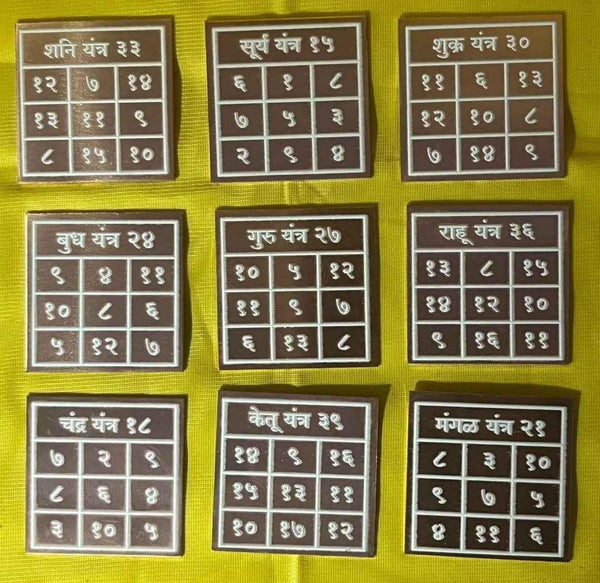
The Pocket Nav Graha Numerical Collection is presented as a collection covering Surya (Sun), Chandra (Moon), Mangal (Mars), Budh (Mercury), Brihaspati or Guru (Jupiter), Shukra (Venus), Shani (Saturn), Rahu, and Ketu.
If you are considering the individual Budh Yantra or the full collection, compare the current price, included products, dimensions, materials, and care instructions on the respective product pages. Avoid relying on older promotional prices or discount percentages without confirming that they are still current.
An individual yantra may suit someone interested in a specific tradition associated with Mercury. A full collection may appeal to someone who collects or uses multiple Navagraha-related objects. The appropriate choice depends on personal beliefs, intended use, and budget—not on a guaranteed difference in spiritual results.
Conclusion
The Pocket Budh Yantra combines a portable format with a numerical design associated with Budh, or Mercury, in Vedic astrology. It may appeal to people interested in traditional yantra worship, a daily mantra routine, or a compact spiritual object that can travel with them.
Its traditional associations include intellect, communication, commerce, learning, and adaptability. These associations are part of Jyotish and devotional practice, not scientifically verified effects of carrying a copper diagram.
If the Pocket Numerical Budh Yantra fits your personal practice, review the current product page for its verified material specifications, dimensions, care instructions, warranty, and price. Use it as a meaningful focus for reflection or worship while continuing to rely on practical preparation and evidence-based methods for education, communication, business, and professional decisions.
Scientific Perspective
Copper and Material Properties
Copper is a good conductor of electricity and heat. These properties can be measured using established scientific methods. Copper also has a long history of use in utensils, decorative objects, and ritual items.
Traditional descriptions of copper as a conductor of prana or subtle energy are spiritual interpretations, not scientifically established material properties. The physical conductivity of copper does not demonstrate that a yantra transmits planetary energy or creates a specific spiritual effect.
Copper is also an essential trace element in human biology, but that fact does not establish that handling or carrying a copper yantra improves brain function, nervous system health, or energy metabolism.
Geometry, Attention, and Meditation
A numerical matrix provides a defined visual pattern that someone may choose to observe during prayer or meditation. A person may find such a practice meaningful or useful as part of a structured routine.
However, the mathematical properties of a numerical grid do not establish that it has supernatural effects. Claims about concentration or meditation outcomes should be supported by relevant research and should not be inferred solely from the design of a particular product.
Traditional References
-
Budha in Jyotish: Budh is one of the Navagrahas and is traditionally associated with intellect, communication, trade, and reasoning. Consult reliable Jyotish references for the specific interpretation used.
-
Budhan Sthalam, Thiruvenkadu: The Swetharanyeswarar Temple at Thiruvenkadu in Tamil Nadu is associated with Budh worship in the Navagraha temple tradition. Verify temple-specific history and ritual details against reliable sources.
-
Numerical Yantra Designs: Mathematical properties of a numerical grid can be checked independently. Its religious symbolism and association with a planet depend on the tradition or source being followed.
-
Copper in Indian Ritual Practice: Copper has a longstanding role in Hindu ritual objects. Spiritual interpretations of the material should be distinguished from measurable physical properties.