
Pure Silver Sri Yantra: What It Is, Why Material Matters, and Who Actually Keeps One
There's a specific kind of buyer who arrives at a Sri Yantra page already skeptical of the language around it — the "manifest anything," "attracts unlimited wealth" copy that shows up on most listings. If you run a business, sit on a board, manage a portfolio, or build a company from scratch, you've likely developed a fairly precise filter for that kind of claim. This guide is written on the other side of that filter — what the Sri Yantra actually is, where the silver-versus-other-metals question genuinely comes from, and how people in demanding, public-facing, or high-stakes roles in Pune actually use one, without the embellishment.
What Is a Sri Yantra?
The Sri Yantra — also called Shri Yantra or Sri Chakra — is a geometric diagram of nine interlocking triangles radiating from a central point, the bindu. Four triangles point upward, representing Shiva or masculine cosmic energy; five point downward, representing Shakti, the feminine, generative force. Where they intersect, they form 43 smaller triangles arranged across several enclosures, traditionally understood in the Sri Vidya tradition as a map of the goddess Lalita Tripura Sundari's cosmic form — a tradition in which Lakshmi's wealth-giving aspect is one expression of a much broader divine feminine principle, not the whole of it.
 −16%
−16%Exclusive Financial Abundance Set — Pure Silver Kuber, Sri & Lakshmi Yantra

Pure Silver Kuber Yantra (Kubera Yantra)

Pure Silver Dashakshar Lakshmi Yantra (Laxmi Yantra)
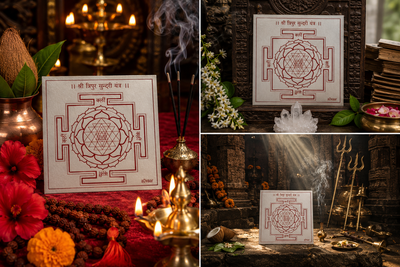
Pure Silver Sri Yantra (Sri Chakram, Shri Yantra, Tripura Sundari Yantra)
 −16%
−16%Pure Silver Yantra (Customisation possible)
That distinction is worth sitting with for a moment, because it's what separates the Sri Yantra from a narrower instrument like a Lakshmi Yantra or Kuber Yantra: it isn't built for one outcome. It's built as a complete cosmological map, which is why the tradition treats it as the most structurally complex — and most commonly misunderstood — of all yantras.
History and Symbolism
The Sri Yantra sits within the Sri Vidya lineage of Tantric worship, one of the oldest continuously practised meditation systems in Indian spiritual history. Its geometry has been drawn and worshipped for centuries as both a meditation object and a ritual instrument — practitioners describe two constructional forms, Bhu-prastara (flat, two-dimensional) and Meru-prastara (raised, pyramid-form), with the latter considered by some traditions to hold a more concentrated field of energy because of its three-dimensional structure.
Spiritual Significance
Within Sri Vidya practice, the yantra is treated as a receiver rather than an object of passive devotion — a fixed structure the practitioner returns their attention to, repeatedly, over years. Traditional teaching holds that its correct use combines three things: the geometric form (yantra), the associated mantra ("Om Shreem Hreem Shreem Kamale Kamalalaye Praseed Praseed, Om Shreem Hreem Shreem Mahalakshmaye Namah" is commonly chanted alongside it), and consistent personal engagement — and that no one of the three substitutes for the other two. This is presented here as devotional teaching and traditional belief, not a guaranteed outcome.
Importance of the Material — Why Silver Specifically
This is the question serious buyers actually ask, and it deserves a direct answer rather than a marketing one. Yantra literature and Sri Vidya teaching consistently note that the metal a yantra is made from affects how long it's traditionally considered fit for sustained worship — silver and gold are held to remain worship-worthy over a much longer span than plain copper or brass, which several traditional sources describe as needing renewal far sooner. This is a belief embedded in the ritual texts, not a chemical or scientific claim, and it's the reason serious, long-term practitioners tend to choose silver or gold over painted or base-metal versions for anything meant to stay in continuous use for decades rather than a season.
Benefits — As Traditionally Understood
Devotees and practitioners describe consistent Sri Yantra worship as supporting mental clarity and decision-making calm, a felt sense of order in the space it occupies, and — specific to its Lakshmi-linked aspect — steadier engagement with money and material responsibility. These are traditional and devotional claims, offered as such, not as financial or medical guarantees.
Who Should Consider It — and Who Might Not
It suits people who want a single, comprehensive instrument rather than several narrow ones, and who are genuinely willing to give it consistent, if brief, attention. It's a poor fit for someone wanting a purely decorative object with no interest in any ongoing engagement — by the tradition's own logic, an unworshipped yantra is simply metal, however finely made.
Vastu Placement
Vastu guidance is consistent across sources: the north-east (Ishaan) corner of a home, pooja room, or office, facing north or east, placed on a raised platform rather than directly on the floor. Friday is the traditionally preferred day for installation, following a simple cleaning ritual for the space.
Daily Worship and Energisation
A short, sustainable practice outperforms an elaborate one abandoned within weeks. Most households and individuals light a lamp or incense near the yantra daily, offer the mantra a fixed number of times (commonly multiples of 9 or 108), and keep the immediate space uncluttered. Formal energisation (prana pratishtha) is traditionally performed by a qualified priest at installation for those seeking the fuller ritual; a simple personal dedication with intention and a lit diya is what most people practise day to day thereafter.
Maintenance and Cleaning
Silver tarnishes naturally with air exposure — this is expected, not a defect. Wipe with a soft, dry cloth; avoid abrasive polish or chemical dips directly on engraved sections, which can dull fine detailing over repeated use. Keep it away from direct incense residue and excess humidity.
How to Identify an Authentic Piece
Look for symmetrical, evenly struck engraving across all 43 triangles rather than a blurred or off-centre pattern, a consistent metal tone, and a seller willing to be explicit about what they can and cannot independently verify. A confident, transparent seller offers a clear return or exchange policy before you buy — that's a better signal than an unverifiable purity claim on its own.
Real-Life Use — By Who's Actually Buying This
For HNI business families: it's most often installed as part of an existing family puja setup, becoming something inherited and maintained across generations rather than a standalone purchase — several buyers describe it as an object that outlasts the business decision it was bought during.
For HNI corporate executives: it tends to sit in a home study or a private office corner, used less as a workplace statement and more as a quiet, five-minute reset before board calls or high-pressure decisions — deliberately kept low-profile rather than displayed.
For HNI celebrities across social media, entertainment, fintech, and sports: people whose income and public standing move with algorithms, box office numbers, market cycles, or a single season's form describe using it as a fixed, private point of routine precisely because so much else in their working life isn't fixed — the appeal is consistency, not visibility, which is also why discretion in packaging and delivery matters more to this group than to most.
For VCs and startup founders: several describe it less as a wealth symbol and more as a grounding object through a stage of work defined by uncertainty — fundraising cycles, portfolio volatility, and decisions made with incomplete information. It's frequently paired with an already-existing habit (morning coffee, a short meditation) rather than treated as a new ritual on its own.
Common Myths
Myth: a bigger or more expensive Sri Yantra is automatically "stronger." Tradition emphasises correct proportion and consistent worship over size. Myth: owning one is sufficient on its own. The Sri Vidya tradition is explicit that engagement, not possession, is what practitioners describe as meaningful.
Common Buyer Mistakes
Choosing based on price or visual appeal alone without checking engraving symmetry, skipping any plan for even minimal ongoing engagement, and not confirming return/exchange terms before purchase are the three most commonly cited regrets among buyers.
Buying Considerations
Decide first whether a broad instrument like the Sri Yantra fits your intention better than a narrower one like a Lakshmi or Kuber Yantra — they're not interchangeable. Confirm engraving quality, material claims, and the seller's after-sale policy before deciding.
Sri Yantra vs. Lakshmi Yantra vs. Kuber Yantra
|
Sri Yantra |
Dashakshar Laxmi Yantra |
Kuber Yantra |
|
|---|---|---|---|
|
Scope |
Broad — full Sri Vidya cosmological form |
Focused — single ten-syllable Lakshmi (Kamala) invocation |
Narrow — wealth retention and management |
|
Structure |
9 interlocking triangles, 43 sub-triangles |
Geometry built to a specific mantra's syllable structure |
Simpler numeric grid |
|
Traditionally chosen for |
A single, comprehensive instrument covering wealth, clarity, and inner balance together |
A contained, singular-intention practice |
Protecting and managing wealth already generated |
|
Common HNI use |
Boardroom/study desk, family altar |
Personal meditation corner |
Business premises, cash management areas |
Why Choose aDvaar
Every aDvaar Sri Yantra is constructed to scripturally accurate proportions rather than a freehand approximation — with a design this geometrically dense, an uneven triangle or an off-centre bindu isn't a cosmetic flaw, it changes whether the form holds up to sustained focus at all. The engraving is done with enough precision that all 43 triangles stay legible rather than blurring into decoration, and the finishing is built for an altar or desk setup meant to stay in place for decades, not one season.
For silver and gold pieces specifically, aDvaar ships with tamper-evident, sealed packaging and in-person quality checks before dispatch, so what leaves our workshop is verified against damage, substitution, or adulteration before it's ever in transit — and delivery across India and internationally is handled through secure, insured logistics rather than standard unmonitored courier, which matters more the more valuable the piece is. If you're building out a broader altar, aDvaar's Dashakshar Laxmi Yantra, Kuber Yantra, and copper yantra range are worth exploring alongside this one, each built for a different, specific intention rather than duplicating what the Sri Yantra already covers.
Tamper-proof Packing:
We provide 100% insurance and tamper proof packing. This is to ensure that our curated pieces reach in the same way as they are packed without damage. If damage occurs we surely leverage the insurance to refund the money.
Secure Door-to-Door Global Delivery:
We use the same method which is being used by premium organisations and jwellers to securely deliver silver or gold products. Hence, customers can easily track and ensure their curated yantras reach them safely across the globe. Yes, the delivery is also under insurance so theft or damage is covered.
Conclusion
The Sri Yantra isn't a shortcut, and the honest version of its pitch was never meant to be one. It's a dense, deliberately complex instrument that rewards people already inclined toward consistency — the kind of discipline that shows up in how a business family, an executive, a founder, or a public figure actually runs their working life, not just how they decorate it. Chosen in silver, built to correct proportion, and placed with basic Vastu awareness, it's a considered addition for someone who already understands what consistent practice is worth. Explore more @ https://advaar.in/products/pure-silver-yantra-sri-yantra-kuber-yantra
FAQs
1. What makes the Sri Yantra different from a Lakshmi Yantra or Kuber Yantra? The Sri Yantra is a broad, complete cosmological instrument within the Sri Vidya tradition, covering wealth, clarity, and balance together. A Lakshmi Yantra or Kuber Yantra is narrower and built around a single specific intention, such as a particular mantra or wealth retention.
2. Why is silver considered significant for a Sri Yantra? Traditional yantra literature holds that silver and gold yantras remain worship-worthy for a far longer span than plain copper or brass ones, which are traditionally described as needing more frequent renewal. This is a belief rooted in ritual texts rather than a scientific claim.
3. Which direction should the Sri Yantra face? Vastu guidance consistently recommends the north-east (Ishaan) direction, facing north or east, ideally placed on a raised platform rather than the floor.
4. Is Friday really the best day to install it? Friday is the traditionally preferred day for Lakshmi-linked worship and is commonly chosen for installation, though any unhurried day allowing a proper cleaning ritual is acceptable.
5. Can a Sri Yantra be kept in a private office or study instead of only at home? Yes — many professionals and business owners keep one in a home study, private office corner, or personal desk, generally used discreetly rather than displayed prominently.
6. Does it require elaborate daily puja? No. Most practitioners maintain a short daily routine — a lit lamp or incense and a brief mantra recitation — rather than an elaborate ceremony. Consistency matters more than duration.
7. How should a silver Sri Yantra be cleaned? With a soft, dry cloth only. Avoid abrasive polish or chemical dips on the engraved surface, since repeated harsh cleaning can dull fine detailing. Tarnishing is a natural property of silver, not a defect.
8. Can I keep a Sri Yantra along with a Lakshmi Yantra or Kuber Yantra in the same space? Yes, multiple yantras can be kept together in a clean, respected space, with each given equal attention rather than one being neglected.
9. Is a Sri Yantra an appropriate gift for a business associate or family member? Yes, it's traditionally considered an auspicious gift, particularly for a new home, office, or business milestone — though the recipient's own willingness to engage with it is what the tradition treats as meaningful.
10. What's the most common mistake buyers make when choosing between a Sri Yantra and a more focused yantra? Buying a Sri Yantra expecting narrow, wealth-only results (better served by a Lakshmi or Kuber Yantra), or the reverse — buying a narrow yantra expecting the broader scope only the Sri Yantra's complete geometry is traditionally understood to hold.