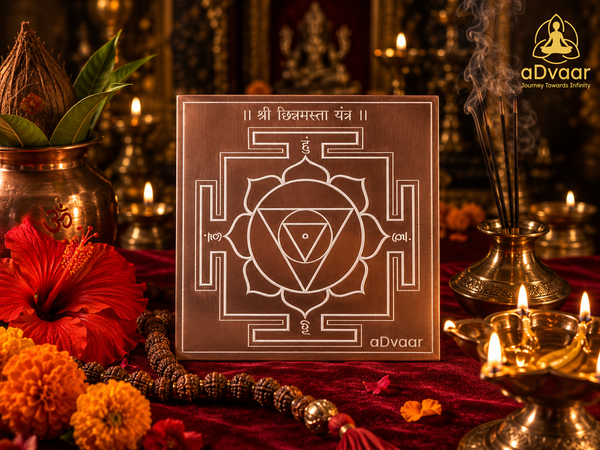

Discover the meaning and traditional significance of the Batuk Bhairav Yantra, its associated mantras, home placement practices, sacred geometry and copper craftsmanship. Learn how Batuk Bhairav differs from Kaal Bhairav, how devotees use a Yantra for meditation and worship, and what to check when choosing a copper Yantra.
Meeting Batuk Bhairav
The Batuk Bhairav Yantra sits at the intersection of Hindu spiritual practice and physical craftsmanship. It is a copper plate engraved with sacred geometry, yet people often seek it for something more personal: a devotional focus associated with protection, calm and direction at home.


Understanding this Yantra begins with its traditional background, the meaning of the deity's name and the role that geometric diagrams play in worship and meditation.
For aDvaar, a Yantra is approached as a sacred geometric support for contemplation and worship, not simply as decorative metalwork. Its traditional significance should be understood separately from the measurable characteristics of its material, construction and engraving.
What Is the Batuk Bhairav Yantra?
A Yantra is a geometric diagram used as a focal point for worship, meditation and contemplation. Within traditional Yantra Shastra, these diagrams follow particular geometric arrangements and are associated with specific deities and spiritual practices.
The Batuk Bhairav Yantra is associated with Batuk Bhairav, a child form of Lord Bhairava. While several Bhairav forms are described through fierce and protective symbolism, Batuk Bhairav is commonly portrayed in devotional sources as a youthful and approachable guardian.
This distinction shapes the traditional understanding of the Yantra. Rather than being viewed simply as a decorative object, it can serve as a visual focus for prayer, mantra recitation and personal devotional practice.
Read What Is a Yantra? Meaning, Purpose, Types, Geometry & How to Use to explore the meaning and traditional use of Yantras in greater detail.
The Meaning Behind the Name: Why Batuk?
The word Batuk means child or youth. Batuk Bhairav refers to Bhairava in his youthful form, while Bhairava is a manifestation of Lord Shiva associated with protection and the removal of negativity in devotional traditions.
The child form occupies a distinctive place in Bhairav worship because it is commonly presented as approachable for household devotion. Some spiritual sources associate Batuk Bhairav with the title Aapaduddharak, referring to the removal or deliverance from difficulties and adversity.
Devotees may therefore turn to Batuk Bhairav as a focus for prayer during periods of uncertainty, fear or perceived obstacles. These associations belong to religious tradition and personal belief; they should not be interpreted as guaranteed outcomes.
Traditional Significance: Benefits and Purpose
Traditional devotional sources associate the Batuk Bhairav Yantra with several intentions.
-
Protection of the home: Batuk Bhairav is commonly approached as a guardian figure in household worship.
-
Removal of fear and obstacles: The Aapaduddharak association connects this form with seeking strength and guidance during difficult circumstances.
-
A focus for discipline: A Yantra can provide a consistent visual anchor for meditation, prayer and mantra recitation.
-
Devotional connection: Keeping a Yantra in a dedicated space can help establish a regular personal worship routine.
These are traditional spiritual associations, not scientifically established effects of the Yantra itself. A Yantra is not an automatic solution to personal difficulties. Its role in a practitioner's life depends on individual belief, intention and consistent practice.
How to Use the Batuk Bhairav Yantra
Devotional practices involving Batuk Bhairav can include mantra recitation, prayer and visual concentration. The appropriate method depends on personal preference and the tradition being followed.
The Mool Mantra
One mantra commonly associated with Batuk Bhairav in devotional sources is:
ॐ बटुक भैरवाय नमः
Om Batuk Bhairavaya Namah.
This is a salutation to Batuk Bhairav. Devotees may use it as part of a simple personal prayer or meditation routine.
The Beej Mantra
Some devotional sources also provide the following mantra:
ॐ बं बटुक भैरवाय नमः
Om Bam Batuk Bhairavaya Namah.
Mantra wording and transliteration can vary between sources and traditions. People following a particular lineage should consult its guidance rather than treating every published version as universally prescribed.
Daily Practice: Japa and Trataka
Japa is the repetition of a mantra as a devotional or contemplative practice. Some devotional sources recommend 108 repetitions, often in the morning.
Another option is Trataka, a visual concentration practice in which the practitioner rests their gaze on a chosen point. When using a Yantra, the geometric centre can serve as the visual anchor, provided the design has a clearly defined central point.
For a simple practice, sit comfortably in a quiet space, settle your breathing and focus on the Yantra for a few minutes. Keep your gaze relaxed, blink naturally and stop if you experience eye strain. Consistency and comfort are more important than forcing a particular duration.
Where to Place the Batuk Bhairav Yantra at Home
Placement is a common question for people exploring Bhairav worship for the first time. Traditional guidance varies, but several practical considerations can help establish a suitable devotional space.
A Clean, Dedicated Space
A prayer room, meditation area, altar or stable shelf can provide an appropriate location. Keep the area tidy and choose a place where the Yantra will not be easily damaged or disturbed.
Direction and Height
Some traditional guidance recommends placing spiritual objects in an east-facing or north-facing arrangement. These preferences vary by tradition and are not universal requirements.
When using the Yantra for visual concentration, place it at a comfortable viewing height so that you can look at the design without straining your neck.
Respectful Placement
Avoid placing the Yantra directly on the floor or in locations where it may be damaged. If you follow a specific devotional tradition, its placement instructions should take precedence.
The purpose of placement is to establish a consistent and respectful setting for personal practice.
Batuk Bhairav Yantra vs Kaal Bhairav Yantra
Batuk Bhairav and Kaal Bhairav are both forms associated with Lord Bhairava, but their traditional symbolism differs.
Kaal Bhairav
Kaal Bhairav is associated with time, discipline, spiritual accountability and protection. He is traditionally revered as the Kotwal, or guardian, of Kashi, also known as Varanasi. His worship appears in a variety of Shaiva devotional and temple traditions.
Explore the aDvaar Kaal Bhairav Yantra.
Batuk Bhairav
Batuk Bhairav is the youthful form of Bhairava. Devotional sources commonly associate this form with approachable household worship, protection and seeking guidance during difficult circumstances.
Explore the aDvaar Batuk Bhairav Yantra.
Neither form is objectively better than the other. The choice depends on the practitioner's interests, devotional tradition and intended practice.
Common Misconceptions About Bhairav Worship at Home
Is Bhairav Worship Only for Initiated Practitioners?
Bhairav worship is practised in public temples and household settings, although particular rituals and advanced Tantric practices may require formal instruction. Simple prayer and devotional observances should be distinguished from specialised lineage-specific rituals.
Can Women Worship a Bhairav Yantra at Home?
Devotional practices vary across traditions, but the supplied research did not identify a reliable basis for a universal gender-based restriction on keeping or worshipping a Batuk Bhairav Yantra at home. People following a particular lineage can consult its guidance regarding specific observances.
Does a Yantra Need to Be Activated by a Priest?
Some traditions include prana pratishtha, a consecration ritual intended to establish a sacred presence in a devotional object. The practice and its significance vary.
A consecration ritual is a matter of religious tradition, not a physical requirement for the copper plate to exist or for its geometry to be viewed during meditation. Buyers who want a consecrated object should verify the seller's specific claims and follow the relevant tradition's guidance.
A Yantra can serve as a visual focus for personal contemplation, while more formal worship may involve additional customary practices.
The Geometry, Material and Craft Behind a Copper Yantra
Yantras use geometric arrangements such as triangles, circles, lotus petals and border patterns. The exact construction depends on the particular Yantra and its traditional design.
Geometry is not merely a decorative feature in Yantra traditions. Its arrangement is associated with the deity and contemplative purpose represented by the diagram. A clearly engraved, well-proportioned design also provides a more legible visual focus during meditation.
Why Material Matters
Copper has a long history of use in religious objects and Yantra construction. Its physical properties, durability and appearance make it a material that buyers may consider when choosing a devotional object.
Material purity, thickness, manufacturing quality and engraving clarity affect the physical characteristics of the finished plate. A product with transparent specifications allows buyers to make a more informed comparison with alternatives.
Read aDvaar's material-focused guide for additional discussion of material selection and the considerations involved in purchasing a Yantra.
A Scientific Perspective: What a Yantra Is and Is Not
A careful explanation of Yantras distinguishes observable physical properties from spiritual interpretations.
What Can Be Examined
-
Geometry and symmetry: The dimensions, proportions and symmetry of an engraved diagram can be inspected and measured.
-
Visual concentration: Trataka is a documented yogic practice involving sustained visual attention. A clearly visible geometric pattern can serve as a focal object.
-
Copper material properties: Copper has measurable physical characteristics, and material composition and thickness can be documented.
-
Construction quality: Engraving clarity, plate thickness, weight and finish can be assessed independently of spiritual beliefs.
What Should Not Be Presented as Scientific Fact
The supplied research did not identify reliable scientific evidence that a Yantra itself changes external events, guarantees protection or produces supernatural outcomes.
Personal experiences of calm, devotion or meaning should be understood within the context of individual practice and religious belief rather than presented as universal scientific results.
This distinction allows the spiritual tradition to be explored respectfully without overstating what scientific evidence can establish.
Buying Guide: What to Check Before You Buy
When choosing a Batuk Bhairav Yantra, consider the following factors.
-
Material composition: Look for a clear statement of the material rather than a vague description such as metal or copper finish.
-
Construction: Check whether the design is engraved into a metal plate rather than printed on thin foil.
-
Geometry: Inspect the clarity, symmetry and proportions of the design.
-
Thickness and weight: Compare the stated measurements with the actual product specifications.
-
Size: Consider whether the Yantra is appropriate for your altar, shelf or intended viewing distance.
-
Seller transparency: Review manufacturing information, product documentation, warranty terms and the seller's contact details.
The aDvaar Batuk Bhairav Yantra is listed as a 4-inch engraved copper Yantra with a stated composition of 95% copper. The supplied product details list a price of ₹899 against an MRP of ₹1,200.
Explore the aDvaar Batuk Bhairav Yantra and the Bhairav Sadhana Collection for the relevant product options. Confirm current pricing, availability, specifications and included accessories on the live product pages.
Why Choose aDvaar?
aDvaar, the Pune-based brand of Lakhlani International, offers Yantras with an emphasis on material disclosure, construction and educational resources.
The supplied Batuk Bhairav Yantra details identify the product as a 4-inch engraved Yantra made from 95% copper.
Material Transparency
Clear information about copper composition, size and construction helps buyers understand the object they are purchasing. Where independent material verification matters, buyers should review available certificates, test reports or other relevant documentation.
Knowledge-Driven Approach
The aDvaar Knowledge Hub provides educational material about Yantras, sacred geometry and material selection. Articles such as What Is a Yantra? provide context for people who want to understand the object before purchasing it.
Regional Manufacturing Context
aDvaar is identified as a Pune-based brand operating under Lakhlani International. The wider Bhairav tradition also has cultural and devotional connections across Maharashtra and other parts of India.
Delivery and Product Information
The product is offered through aDvaar's online store, with delivery information provided through the relevant product and checkout pages. Buyers should consult the live listing for the latest delivery estimates and service availability.
Choosing a Yantra should involve understanding the tradition, examining the physical object and checking the seller's stated specifications, rather than relying solely on promotional claims.
Conclusion
The Batuk Bhairav Yantra brings together devotional tradition, sacred geometry and physical craftsmanship. Its association with Bhairav in his youthful form gives it a distinctive place in household worship and personal contemplative practice.
A copper Yantra is also a physical object whose material, dimensions, engraving and finish can be examined. Understanding both aspects helps buyers approach the tradition with reverence while making informed purchasing decisions.
For those interested in Batuk Bhairav and a geometric focus for prayer or meditation, the aDvaar Batuk Bhairav Yantra offers a starting point for further exploration. Its meaning develops through the practitioner's own understanding, intention and consistent practice.
Frequently Asked Questions
1. What is the Batuk Bhairav Yantra?
The Batuk Bhairav Yantra is a geometric diagram associated with Batuk Bhairav, the youthful form of Lord Bhairava. It is traditionally used as a focal point for worship, meditation and contemplation.
2. What are the traditional benefits of the Batuk Bhairav Yantra?
Traditional devotional sources associate it with protection, seeking relief from fear and obstacles, and establishing a regular devotional practice. These are religious associations and personal intentions, not guaranteed or medically established outcomes.
3. What does Batuk mean?
Batuk means child or youth. The name refers to Bhairava in his youthful form, which devotional sources commonly describe as approachable for household worship.
4. How do I use the Batuk Bhairav Yantra?
You may use the Yantra as a visual focus for prayer, mantra recitation or meditation. Some devotional sources recommend chanting the Mool Mantra 108 times. Practices vary, so follow the guidance of your own tradition where applicable.
5. Where should I place the Yantra at home?
A clean, dedicated prayer area, meditation space or stable shelf is a practical choice. Some traditional guidance prefers an east-facing or north-facing arrangement, but placement customs vary.
6. Which mantra is associated with Batuk Bhairav?
A commonly cited Mool Mantra is ॐ बटुक भैरवाय नमः (Om Batuk Bhairavaya Namah). Some devotional sources also provide a Beej Mantra: ॐ बं बटुक भैरवाय नमः (Om Bam Batuk Bhairavaya Namah). Wording and transliteration can vary by source and tradition.
7. What is the difference between Batuk Bhairav and Kaal Bhairav?
Kaal Bhairav is associated with time, discipline and the guardianship of Kashi. Batuk Bhairav is the youthful form of Bhairava, commonly associated with approachable household devotion. Both have distinct places in Bhairav traditions.
8. Is Bhairav worship suitable for the home?
Household devotion to Bhairav is practised in various traditions. Simple prayer and the use of a Yantra as a devotional focus should be distinguished from advanced Tantric rituals, which may require qualified instruction.
9. How should I clean and maintain a copper Yantra?
Gently remove dust with a soft, dry cloth. If necessary, use a lightly dampened cloth and dry the plate promptly. Avoid abrasive materials and harsh chemical cleaners that could affect the engraving or finish. Copper may naturally develop a patina over time.
10. Where can I buy a Batuk Bhairav Yantra online in India?
aDvaar lists the Batuk Bhairav Yantra through its online store. The supplied details identify it as a 4-inch engraved Yantra with a stated copper composition of 95%. Check the live product listing for current pricing, availability, specifications and delivery information.
Research Basis
Traditional References
-
Shiva Purana: Referenced in secondary devotional sources for traditional narratives concerning Bhairava.
-
Skanda Purana: Cited in material concerning Kaal Bhairav and the traditional guardianship of Kashi.
-
Kaal Bhairav Temple, Varanasi: The Kashi District portal provides information about the temple and its devotional context.
-
Mantra traditions: Secondary spiritual publications provide examples of Batuk Bhairav Mool and Beej Mantras and the custom of 108 repetitions.
-
Regional devotional practices: Bhairav worship varies across India, including Maharashtra and Varanasi.
Additional Reading and Product References
-
aDvaar. “Batuk Bhairav Yantra.” https://advaar.in/products/authentic-batuk-bhairav-yantra
-
aDvaar. “Bhairav Sadhana Collection.” https://advaar.in/products/bhairav-sadhna-yantras
-
aDvaar Knowledge Hub. “What Is a Yantra? Meaning, Purpose, Types, Geometry & How to Use.” https://advaar.in/blogs/advaar-knowledge-hub/what-is-a-yantra
-
aDvaar Knowledge Hub. “Pure Silver Sri Yantra: What It Is, Why Material Matters, and Who Actually Keeps One.” https://advaar.in/blogs/advaar-knowledge-hub/pure-silver-sri-yantra-what-it-is-why-material-matters-and-who-actually-keeps-one
-
Official Kashi District portal. Shri Kaal Bhairav Temple. https://kashi.gov.in
-
AstroTalk. Batuk Bhairav mantra resources.
-
Anytime Astro. Batuk Bhairav devotional article.
-
The Sanatan Tales. Batuk Bhairav devotional article.
-
TemplePurohit. Lord Bhairav and related devotional traditions.
-
Kalyan Geetha. Regional temple-history article concerning Batuk Bhairav and Varanasi.
Editorial standard: Traditional beliefs are identified as such; product specifications are attributed to the supplied aDvaar product information; historical and scientific claims are limited to their stated scope; and advanced Tantric practices are not presented as do-it-yourself instructions.