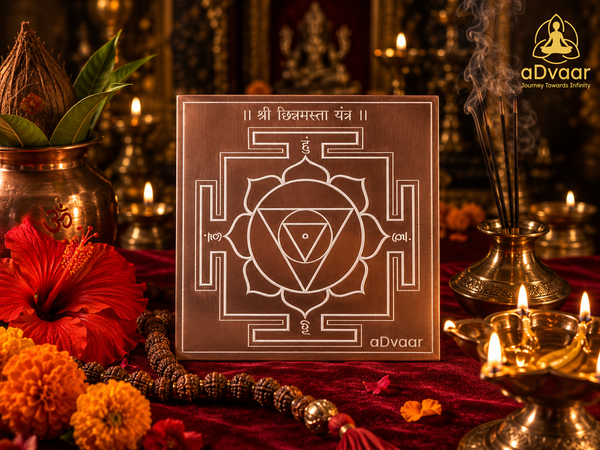

Discover the Akash Bhairav Yantra, its connection to the ether element, traditional space-clearing practices, sacred geometry, copper material properties and Trataka meditation. Learn about its significance, home placement, Bhairav traditions and how to choose a copper Yantra with transparent material specifications.
Meeting Akash Bhairav
The Pancha Bhuta framework describes five elements—earth, water, fire, air and ether—that classical Indian philosophy uses to understand the universe. Each element carries its own philosophical significance and associations with spiritual practice.


Akash Bhairav is associated with Akasha, the ether or space element. Within this traditional framework, Akasha represents spaciousness, subtlety and the space in which other elements exist. The Akash Bhairav Yantra provides a geometric focus for those exploring Bhairav worship, elemental symbolism and Yantra meditation.
For aDvaar, a Yantra is approached as a sacred geometric support for contemplation and worship, rather than simply as decorative metalwork. Understanding its traditional meaning alongside its material construction helps distinguish spiritual beliefs from verifiable physical properties.
What Is the Akash Bhairav Yantra?
The Akash Bhairav Yantra is a sacred geometric diagram associated with Akash Bhairav, a form of Lord Bhairava connected to the ether or space element in the Pancha Bhuta tradition.
Bhairava is a fierce manifestation of Lord Shiva. Different Bhairav forms carry distinct associations within Hindu devotional and Tantric traditions. Kaal Bhairav is associated with time, discipline and spiritual accountability; Batuk Bhairav is commonly approached as a protective, youthful form; and Swarna Akarshan Bhairav is associated with abundance.
The aDvaar Bhairav Sadhana Collection brings together six Bhairav forms, each representing a different spiritual focus.
Unlike a murti, which is a figurative representation of a deity, a Yantra is an abstract geometric diagram. Devotees may use it as a visual focus for prayer, meditation and contemplation.
Those new to Bhairav worship may also find it useful to understand the distinction between a deity's traditional representation and the format used for worship. Yantras are commonly used in home devotional settings, although specific practices and placement customs vary across traditions.
Why Akash? The Ether Element in Yantra Tradition
In the Pancha Bhuta framework, Akasha, or ether and space, is considered the subtlest of the five elements. Earth, water, fire and air are associated with tangible aspects of experience, while Akasha represents the space in which everything else exists.
Traditional Indian philosophical systems also associate Akasha with sound and vibration.
Within this symbolic framework, the Akash Bhairav Yantra is associated with three principal intentions:
-
Space clearing: Supporting a devotional intention to address feelings of stagnation or heaviness in a physical environment.
-
Elemental balance: Representing the ether element in relation to the other four elements.
-
Mental spaciousness: Providing a visual focus for meditation, reflection and a sense of openness.
These are traditional spiritual interpretations rather than scientifically established effects of the Yantra itself.
Other aspects can be examined independently. The product's material composition and dimensions can be documented, geometric proportions can be measured, and Trataka meditation has been investigated in peer-reviewed research on attention and visuospatial working memory.
Why This Yantra? Understanding the Different Bhairav Forms
Several Bhairav forms appear in Hindu devotional traditions. Understanding their traditional associations can help practitioners explore the form that aligns with their interests.
Kaal Bhairav
Kaal Bhairav is widely associated with time, discipline, spiritual accountability and protection. He is traditionally revered as the guardian of Kashi, or Varanasi. Stories of his origin appear in traditional Shaiva literature, including the Shiva Purana.
Explore the aDvaar Kaal Bhairav Yantra.
Batuk Bhairav
Batuk Bhairav is a youthful form of Bhairava. Devotees commonly associate this form with protection, obstacle removal and stability. In some devotional traditions, Batuk Bhairav is considered approachable for household worship.
Explore the aDvaar Batuk Bhairav Yantra.
Akash Bhairav
Akash Bhairav represents a different emphasis within this symbolic framework: ether, space, expansiveness and clarity. For people interested in Bhairav worship alongside meditation and elemental symbolism, this form offers a distinct point of exploration.
Questions about whether Bhairav can be worshipped at home often depend on the particular form, representation and lineage. A murti and a Yantra are different types of devotional objects, and guidance can vary by tradition. Those following a specific lineage should observe its instructions.
The Science Behind the Copper
The aDvaar Akash Bhairav Yantra is specified as being made from 95%+ pure electrolytic copper, with a thickness of 1 mm or more, a weight of approximately 90–95 g and a natural copper matte finish. The reverse side is left raw and uncoated.
What Is Electrolytic Copper?
Electrolytic refining is a process used to produce high-purity copper. Copper purity and material quality matter in applications requiring consistent physical properties, including electrical and industrial manufacturing.
For a Yantra, clear specifications can help buyers understand the material, construction and expected durability of the object. Actual product composition should be assessed using the manufacturer's documentation and any relevant testing or certification.
Copper and Antimicrobial Properties
Copper and certain copper alloys have documented antimicrobial properties under specified laboratory conditions. The US Environmental Protection Agency registered certain copper alloys as antimicrobial materials in 2008.
Laboratory testing has demonstrated substantial reductions in particular bacteria on qualifying copper-alloy surfaces under defined test conditions. These findings concern the material's physical properties; they do not establish that a copper Yantra purifies an entire room, prevents illness or produces a spiritual outcome.
The material benefits of copper should therefore be distinguished from traditional beliefs about the spiritual significance of copper.
Material Transparency and Sacred Geometry
The aDvaar Yantra specification emphasizes copper purity, thickness, weight and finish. These details allow buyers to make a more informed assessment of construction quality.
Sacred geometry, meanwhile, refers to geometric patterns and proportions used in religious and contemplative traditions. Their dimensions can be measured, while interpretations concerning divine energy or spiritual resonance belong to traditional belief.
Read What Is a Yantra? Meaning, Purpose, Types, Geometry & How to Use to explore the relationship between Yantra geometry, material and devotional practice.
Sacred Geometry and Trataka Meditation
Trataka is a yogic practice of sustained visual concentration. Classical Hatha Yoga literature describes it among the Shatkarmas, or cleansing techniques. The practice involves steady gazing at a single point, followed in some methods by closing the eyes and observing the residual visual image.
A 2021 study by Swathi, Bhat and Saoji, published in Frontiers in Psychology (DOI: 10.3389/fpsyg.2021.773049), investigated Trataka and performance on the Corsi-Block Tapping Task, a standardized measure of visuospatial working memory and spatial attention.
An earlier study by Raghavendra and Singh, published in the Journal of Traditional and Complementary Medicine in 2016, examined Trataka and cognitive performance.
These studies provide research into particular cognitive measures and meditation practices. They do not establish that a specific Yantra produces supernatural effects or guarantees improvements for every practitioner.
How to Use a Yantra for Trataka
For a simple visual concentration practice:
-
Place the Yantra at a comfortable viewing height in a quiet, well-lit space.
-
Sit comfortably and allow your breathing to settle.
-
Rest your gaze on a central geometric point, such as the bindu, if the design includes one.
-
Keep your gaze relaxed and blink whenever needed. Do not force yourself to continue if your eyes become uncomfortable.
-
Close your eyes when you finish and sit quietly for a short period.
Begin with a few minutes and increase the duration only if comfortable. People experiencing eye strain or discomfort should stop the practice.
A Yantra can provide a stable visual anchor for meditation. The benefits of the practice depend on the individual and the way it is performed, rather than on a guaranteed effect from the object.
Placement and Home Practice
Where to Place the Yantra
Traditional placement guidance often recommends keeping a Yantra in a clean, dedicated space, such as a prayer corner, meditation area or suitable shelf.
Some traditions prefer an east-facing placement. These recommendations vary, so practitioners may follow the instructions associated with their own devotional tradition.
Choose a location where the Yantra can be kept clean and approached respectfully. Avoid unstable surfaces, cluttered areas or places where the object may be damaged.
A Simple Daily Practice
A simple personal practice may include a few minutes of quiet contemplation, focused gazing or prayer. Devotees who follow the relevant tradition may also recite a mantra such as "Om Akash Bhairavaya Namah."
A lamp or flower offering may be included according to personal preference and customary practice. Elaborate rituals are not necessary for someone simply using a Yantra as a visual focus for reflection.
People interested in formal or advanced Tantric worship should seek guidance from a qualified teacher within the relevant tradition rather than treating an online article as a complete ritual instruction.
When to Worship
Kalashtami, the eighth lunar day associated with the waning moon, is traditionally considered significant for Bhairav worship. Maha Shivaratri and the month of Sawan are also important within broader Shaiva devotional traditions.
Observances and calendars vary. A Yantra may also be used for personal contemplation outside these occasions, depending on the practitioner's tradition and intention.
Who Should Consider the Akash Bhairav Yantra?
The Akash Bhairav Yantra may be of interest to several groups of practitioners:
-
Meditation practitioners: Those looking for a geometric visual focus for concentration and contemplative practice.
-
People interested in elemental philosophy: Those exploring the Pancha Bhuta framework and the traditional symbolism of Akasha.
-
People exploring Bhairav worship: Those seeking to understand the different Bhairav forms and their devotional associations.
-
Buyers who value material transparency: Those who want clear information about copper composition, thickness, weight and finish.
The Yantra should be understood as a spiritual or contemplative object, not as a substitute for medical treatment, financial advice or professional guidance. Traditional associations with space clearing and elemental balance should not be interpreted as scientifically proven environmental effects.
Why Choose aDvaar?
aDvaar offers copper Yantras manufactured in Pune, Maharashtra, with an emphasis on documented material specifications and sacred geometry.
The Akash Bhairav Yantra's stated specifications include:
-
Copper composition: 95%+ pure electrolytic copper.
-
Thickness: 1 mm or more.
-
Weight: Approximately 90–95 g.
-
Finish: Natural copper matte finish.
-
Reverse side: Raw and uncoated.
-
Material assurance: aDvaar states that it provides a lifetime material quality warranty.
The brand also identifies its business credentials as MSME-registered and Startup India recognised. Buyers who need to verify these claims can consult the relevant business documentation.
The stated delivery estimate is 3–7 days for pan-India delivery, with express options subject to availability.
Explore the Bhairav Sadhana Collection
The aDvaar Bhairav Sadhana Collection brings together six Bhairav forms:
-
Kaal Bhairav
-
Akash Bhairav
-
Batuk Bhairav
-
Krodh Bhairav
-
Unmat Bhairav
-
Swarna Akarshan Bhairav
The supplied collection details list a price of ₹5,299 against an MRP of ₹8,000 and mention a Bhairav Sadhana guide, protective case and black thread. Confirm the current product listing for the latest price, included items and availability.
Akash Bhairav in Traditional Context
Pancha Bhuta: The Five Elements
Pancha Bhuta is a foundational concept in several Indian philosophical, Ayurvedic and yogic traditions. Its five elements are Prithvi (earth), Ap or Jala (water), Agni or Tejas (fire), Vayu (air) and Akasha (ether or space).
The elements function as philosophical and traditional categories, rather than a direct equivalent of the modern scientific periodic table. Akasha is commonly associated with sound and space in traditional explanations.
Bhairav Traditions
Bhairava is a form of Lord Shiva revered across multiple Hindu traditions. Texts and regional practices present different forms, narratives and devotional approaches. The Vigyan Bhairava Tantra explores contemplative practices associated with Bhairava, while the Shiva Purana includes narratives about Kaal Bhairav.
The meaning and practice associated with a particular form can differ by lineage and region. Readers should distinguish these traditional accounts from independently verifiable historical claims.
Bhairav Worship in Maharashtra
Bhairavnath is worshipped in various parts of Maharashtra, including rural communities where local guardian deities play an important cultural and devotional role. Regional temples and practices vary, reflecting the diversity of local traditions.
Akash Bhairav in Nepal
The Akash Bhairav tradition is associated with Kathmandu, Nepal, including the temple at Indra Chowk and the Yenya, or Indra Jatra, festival. Festival practices and traditional narratives connect the deity with Kathmandu's cultural and religious heritage.
Historical accounts of the deity's origins and associations should be attributed to the relevant sources, particularly where dates or legendary figures are concerned.
Conclusion
The Akash Bhairav Yantra brings together several subjects worth exploring: the Pancha Bhuta philosophy, Bhairav devotional traditions, sacred geometry, copper material properties and Trataka meditation.
Its association with Akasha offers a traditional framework for reflecting on space, awareness and expansiveness. Copper composition, thickness, weight and finish provide separate, practical considerations when assessing the physical object.
For those interested in the ether element and a geometric focus for meditation, the aDvaar Akash Bhairav Yantra offers a starting point for exploring this tradition. Its significance ultimately depends on the practitioner's understanding, intention and devotional context.
Frequently Asked Questions
1. What is an Akash Bhairav Yantra?
The Akash Bhairav Yantra is a sacred geometric diagram associated with Akash Bhairav, a form of Lord Bhairava connected to the ether or space element in the Pancha Bhuta tradition. Devotees may use it as a focus for meditation, prayer and contemplation. Unlike a murti, a Yantra is an abstract geometric pattern.
2. What does Akash mean in Hindu tradition?
Akash refers to ether or space, one of the five elements in the Pancha Bhuta framework. Traditional Indian philosophical systems associate it with subtlety, space, sound and vibration. Akash Bhairav is understood through this symbolic association.
3. Can I keep a Bhairav Yantra at home?
Yantras are commonly used as devotional and contemplative objects in home settings. Specific placement customs and worship instructions vary by tradition. If you follow a particular lineage, consult its guidance on the form of Bhairav and the intended practice.
4. How is Akash Bhairav different from Kaal Bhairav?
Kaal Bhairav is traditionally associated with time, discipline, spiritual accountability and protection. Akash Bhairav is associated with Akasha, or ether and space, and its symbolism of spaciousness and subtlety. Both belong to the broader Bhairav tradition but emphasize different qualities.
Explore the Kaal Bhairav Yantra and Akash Bhairav Yantra.
5. How should I place the Akash Bhairav Yantra?
Keep the Yantra in a clean, dedicated space, such as a prayer corner, meditation area or suitable shelf. Some traditional guidance recommends an east-facing placement, although customs vary. Choose a stable location where the Yantra can be kept clean and approached respectfully.
6. What is Trataka, and how can I practice it with this Yantra?
Trataka is a yogic visual concentration practice involving steady gazing at a chosen point. Place the Yantra at a comfortable viewing height, relax your gaze on a central geometric point and practise for a few minutes as comfortable. Blink naturally and stop if you experience eye strain. Research has examined Trataka's relationship with specific measures of attention and visuospatial working memory, but individual results vary.
7. Is the aDvaar Akash Bhairav Yantra made from pure copper?
According to the supplied aDvaar product specifications, the Yantra uses 95%+ pure electrolytic copper, is at least 1 mm thick, weighs approximately 90–95 g and has a natural copper matte finish. The reverse side is uncoated. Buyers seeking independent confirmation of material composition should consult the available product documentation and testing records.
8. What is the Bhairav Sadhana Collection?
The aDvaar Bhairav Sadhana Collection is described as a set of six Bhairav-form Yantras: Kaal Bhairav, Akash Bhairav, Batuk Bhairav, Krodh Bhairav, Unmat Bhairav and Swarna Akarshan Bhairav. The supplied product details list a price of ₹5,299 against an MRP of ₹8,000 and mention a guide, protective case and black thread. Check the current listing for updated pricing and availability.
9. When is the best time to worship the Akash Bhairav Yantra?
Kalashtami is traditionally considered significant for Bhairav worship. Maha Shivaratri and Sawan are also important in broader Shaiva devotional traditions. Observances vary, and the Yantra may also be used for personal contemplation outside these occasions according to the practitioner's tradition.
10. What makes aDvaar's copper Yantras different?
The supplied product specifications emphasize 95%+ electrolytic copper, a thickness of at least 1 mm, a weight of approximately 90–95 g, a natural copper matte finish and sacred geometry. aDvaar also states that it offers a lifetime material quality warranty. Buyers can compare these details with the material disclosures, documentation and warranty terms provided by other sellers.
Research Basis
Scientific and Material References
-
Swathi PS, Bhat R, Saoji AA. “Effect of Trataka (Yogic Visual Concentration) on the Performance in the Corsi-Block Tapping Task: A Repeated Measures Study.” Frontiers in Psychology. 2021;12:773049. DOI: 10.3389/fpsyg.2021.773049. PMID: 34975664. PMCID: PMC8718544.
-
Raghavendra B, Singh R. “Effect of Trataka on Cognitive Functions.” Journal of Traditional and Complementary Medicine. 2016. PMCID: PMC4738033.
-
Copper Development Association. “Antimicrobial Copper.” https://www.copper.org/education/c-facts/antimicrobial/print-category.html
-
US EPA copper-alloy antimicrobial stewardship resource. https://copperalloystewardship.com/
-
aDvaar. “Akash Bhairav Yantra.” https://advaar.in/products/akash-bhairav-yantra
-
aDvaar. “What Is a Yantra? Meaning, Purpose, Types, Geometry & How to Use.” https://advaar.in/blogs/advaar-knowledge-hub/what-is-a-yantra
Traditional and Cultural References
-
Hatha Yoga Pradipika, Chapter 2, for the traditional description of Trataka among the Shatkarmas.
-
Vigyan Bhairava Tantra, for contemplative practices associated with Bhairava.
-
Shiva Purana, for traditional narratives concerning Kaal Bhairav.
-
Pancha Bhuta: traditional Indian philosophical and yogic accounts of the five elements.
-
Bhairava traditions and regional temple practices, including Akash Bhairav in Kathmandu, Nepal.
Additional Reading and Product References
-
aDvaar. “Pure Silver Sri Yantra: What It Is, Why Material Matters, and Who Actually Keeps One.” https://advaar.in/blogs/advaar-knowledge-hub/pure-silver-sri-yantra-what-it-is-why-material-matters-and-who-actually-keeps-one
-
aDvaar. “Bhairav Sadhana Collection.” https://advaar.in/products/bhairav-sadhna-yantras
-
Wikipedia. “Akash Bhairav.” https://en.wikipedia.org/wiki/Akash_Bhairav
-
Wikipedia. “List of Bhairava Temples.” https://en.wikipedia.org/wiki/List_of_Bhairava_temples
-
Wikipedia. “Pancha Bhuta.” https://en.wikipedia.org/wiki/Pancha_Bhuta
-
Wikipedia. “Bhairava.” https://en.wikipedia.org/wiki/Bhairava
Editorial standard: Traditional beliefs are identified as such; scientific findings are limited to the outcomes actually studied; product specifications are attributed to aDvaar; and advanced Tantric practices are not presented as do-it-yourself ritual instructions.