
The Pure Silver Sri Yantra: A Sourcing and Specification Guide for Interior Designers and Architects in Mumbai, Pune, Maharashtra & India
If you design or build premium homes in Mumbai, Pune, Maharashtra or India, you've almost certainly had this conversation already: a client, midway through finalising their puja room or home office, asks whether you can "also handle" the Vastu elements — the yantra, the placement, sometimes the whole ritual setup. It's rarely in the original brief, and it's exactly the kind of request where getting it wrong (a mismatched finish, an unverifiable "authentic" claim, a piece that arrives late for handover) reflects on you, not just the vendor. This guide is written for that specific position — sourcing and specifying a Pure Silver Sri Yantra with the same rigour you'd apply to any other premium fixture.
What Is a Sri Yantra, in Terms Worth Explaining to a Client
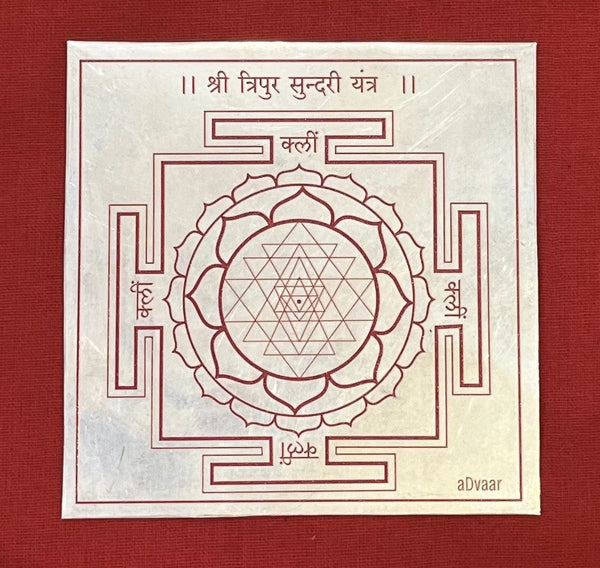
The Sri Yantra — also called Shri Yantra or Sri Chakra — is a geometric diagram of nine interlocking triangles radiating from a central bindu: four pointing upward (Shiva, masculine energy), five downward (Shakti, feminine energy), together forming 43 smaller triangles across several enclosures. Within the Sri Vidya tradition, it's understood as a complete map of the goddess Lalita Tripura Sundari's cosmic form, with Lakshmi's wealth-giving aspect as one part of a broader whole — not a narrow, single-purpose wealth charm. That's a useful, accurate line to have ready when a client asks "what does this actually do," because it separates the Sri Yantra clearly from narrower instruments like a Lakshmi or Kuber Yantra, which you may also be asked to source.
History and Symbolism
The Sri Yantra belongs to the Sri Vidya lineage of Tantric worship, one of the longest continuously practised meditation traditions in Indian spiritual history. It exists in two constructional forms — Bhu-prastara (flat) and Meru-prastara (raised, pyramid-form) — a distinction worth knowing when a client's design language leans toward one or the other; the Meru form has a sculptural presence and often sits better as a standalone piece in an open pooja alcove, while the flat form integrates more discreetly into a wall-mounted or shelf setup.
Why This Is Relevant to Your Work Right Now
Vastu-aligned planning has moved from a private client preference to an explicit part of how premium real estate is being marketed and designed in 2026 — multiple market reports on South Mumbai's, West Pune or any luxury segment describe Vastu-aligned layouts sitting alongside sea-facing views and premium finishes as a stated buyer priority, not an afterthought bolted on at handover. Interior design trend coverage separately notes that Vastu-for-interiors remains one of the most consistently searched planning terms among Indian homeowners. Practically, that means more of your briefs will include a Vastu component whether or not you specialise in it, and having a reliable, verifiable source for pieces like this is becoming as relevant to your workflow as your finish and fixture vendors already are.
Spiritual Significance — What to Communicate, and What Not To
Within Sri Vidya practice, the yantra is treated as a receiver rather than decoration — a fixed structure the client returns their attention to over years, alongside its mantra and consistent personal engagement. It's worth being precise with clients here: this is traditional and devotional teaching, not a guaranteed outcome, and framing it that way protects your credibility as much as the vendor's.
Why the Material Matters — The Question Every Client Asks
Silver comes up constantly, and it deserves a straight answer. Yantra literature and Sri Vidya teaching consistently hold that silver and gold yantras remain worship-worthy over a far longer span than plain copper or brass, which several traditional sources describe as needing more frequent renewal. This is a belief embedded in ritual texts, not a chemical claim — but it's the reason clients furnishing a permanent puja space, rather than a temporary one, tend to specify silver or gold rather than a painted or base-metal version.
Vastu Placement — What You'll Be Asked to Confirm
Guidance is consistent across sources: the north-east (Ishaan) corner of the home or office, facing north or east, on a raised platform rather than the floor. Friday is the traditionally preferred installation day. This is worth building into your handover checklist alongside electrical and plumbing sign-offs, since it's frequently the last thing finalised before a client moves in.
Maintenance — What to Tell Clients Post-Handover
Silver tarnishes naturally with air exposure; this is expected, not a defect, and it's worth pre-empting so you don't field a "damaged product" complaint six months post-handover. A soft, dry cloth is sufficient — abrasive polish or chemical dips on the engraved surface will dull fine detailing over time.
How to Vet Authenticity Before You Specify It
Look for symmetrical, evenly struck engraving across all 43 triangles, a consistent metal tone, and — critically for your position — a vendor who documents what they can and cannot independently verify, rather than an unverifiable purity claim you'd have to defend to your client later. A transparent return/exchange policy and clear sourcing information matter more here than they would for a typical retail buyer, because you're the one whose name is attached to the recommendation.
Real-Life Use — By Who's Actually Specifying This
For premium interior designers: the most common scenario is a client's home puja room or private altar, where the yantra needs to sit correctly within the room's existing material palette — silver against marble, teak, or brass fixtures — while still meeting the correct Vastu orientation. Designers who source this well typically build a repeat relationship with one vendor across several client homes, rather than sourcing fresh each time, precisely because consistency and verifiable authenticity matter more than a one-off discount.
For elite real estate architects: this shows up more at the project level — a developer or architect building Vastu-aligned planning into a premium residential tower or villa community from the design stage, where the Sri Yantra (or a Vastu consultant's broader recommendation set) becomes part of the standard fit-out specification across multiple units rather than a single client request. Here, consistency of quality across a bulk order and dependable lead times against a handover schedule matter as much as the piece's authenticity.
Common Mistakes to Avoid on a Client's Behalf
Sourcing on price alone without checking engraving symmetry or the vendor's documentation, leaving Vastu placement as an unconfirmed line item until the week of handover, and assuming a decorative or painted version will satisfy a client who specifically asked for an authentic metal piece — these are the three issues that most often come back to the designer or architect, not the original vendor.
Buying and Specification Considerations
Decide early whether the brief calls for a Sri Yantra — a broad, complete instrument — or a narrower one like a Lakshmi or Kuber Yantra, since they serve different client intentions and aren't interchangeable substitutes. For project-scale work, confirm minimum order handling, consistent finish across units, and turnaround against your handover calendar before committing a vendor to the spec.
Sri Yantra vs. Lakshmi Yantra vs. Kuber Yantra — For Client Conversations
|
Sri Yantra |
Dashakshar Laxmi Yantra |
Kuber Yantra |
|
|---|---|---|---|
|
Scope |
Broad — full Sri Vidya cosmological form |
Focused — single ten-syllable Lakshmi (Kamala) invocation |
Narrow — wealth retention and management |
|
Best fits |
Clients wanting one comprehensive piece for a main altar. Clients wanting both protection and increased wealth |
Clients wanting a smaller, contained meditation focus point and increased sources of income |
Clients specifically asking about business or cash-area placement and strengthening of existing income sources |
|
Typical spec context |
Primary home puja room, developer-standard fit-out |
Personal meditation corner |
Home office, retail or commercial unit |
Why Choose aDvaar
Every aDvaar Sri Yantra is built to scripturally accurate proportions rather than a freehand approximation — at this level of geometric density, an uneven triangle or off-centre bindu isn't cosmetic, it changes whether the form is correct at all, which matters when you're the one certifying it to a client. Engraving precision keeps all 43 triangles legible, and the finishing is built for permanent installation, not a piece that needs replacing within a year of handover.
For silver and gold pieces specifically, aDvaar ships with tamper-evident, sealed packaging and in-person quality checks before dispatch, with secure, insured logistics for delivery across Mumbai and beyond — documentation you can pass on to clients directly, and consistency you can rely on across multiple projects without re-vetting a new source each time. Alongside the Sri Yantra, aDvaar's Dashakshar Laxmi Yantra, Kuber Yantra, and copper yantra range cover the narrower Vastu-remedy requests that come up alongside a primary altar piece.
Tamper-proof Packing:
We provide 100% insurance and tamper proof packing. This is to ensure that our curated pieces reach in the same way as they are packed without damage. If damage occurs we surely leverage the insurance to refund the money.
Secure Door-to-Door Global Delivery:
We use the same method which is being used by premium organisations and jwellers to securely deliver silver or gold products. Hence, customers can easily track and ensure their curated yantras reach them safely across the globe. Yes, the delivery is also under insurance so theft or damage is covered.
Durability Test:
Most market Silver yantras damage or wither off after 1 or 2 washes. aDvaar Yantras are tested for repeated washes. We use the same technology across all our variants be it pure copper, pure silver or pure gold. Hence, when handled properly our yantras are more durable than market yantras. See our unedited durability test here.
Conclusion
For a designer or architect, a Sri Yantra request is rarely just a product ask — it's a small but visible test of whether your sourcing holds up to the same standard as everything else in the project. Specified correctly, in silver, to accurate proportion, with placement confirmed early rather than left to the final week, it's one more premium detail that reflects well on the work around it rather than standing apart from it.
Refer:
- https://advaar.in/pages/blogs
- https://advaar.in/products/pure-silver-yantra-sri-yantra-kuber-yantra
FAQs
1. What's the difference between a Sri Yantra and a Lakshmi Yantra when specifying for a client? The Sri Yantra is a broad, complete Sri Vidya instrument covering wealth, clarity, and balance together, generally suited as a primary altar piece. A Lakshmi or Kuber Yantra is narrower, built around a single intention, and often better suited to a secondary meditation corner or a business/cash-area request.
2. Why do clients specifically ask for silver rather than brass or copper? Traditional yantra literature holds that silver and gold pieces remain worship-worthy and have increased purity with a much longer span than brass or copper, which are traditionally described as needing more frequent renewal. It's a belief rooted in ritual texts rather than a chemical claim, but it's the reason clients furnishing a permanent altar tend to specify it.
3. Where should the Sri Yantra be placed in a floor plan? Vastu guidance consistently points to the north-east (Ishaan) direction, facing north or east, on a raised platform rather than the floor — worth confirming early in the design process rather than at final handover.
4. Can this be specified across multiple units in a single development? Yes — for project-scale specification, confirm consistent finish and engraving quality across the order along with turnaround time against your handover schedule, since these matter more at volume than for a single retail purchase.
5. What documentation should I be able to give a client about authenticity? Ask your vendor for clear sourcing information and what they can and can't independently verify (such as purity testing), rather than accepting an unverifiable claim you'd have to stand behind yourself later.
6. How should clients be told to maintain a silver Sri Yantra post-handover? A soft, dry cloth only — tarnishing is a natural property of silver, not a defect, and it's worth pre-empting with clients so it isn't mistaken for a product issue after handover.
7. Does the Sri Yantra need to match the room's material palette? It doesn't need to structurally, but designers commonly consider how the silver tone reads against surrounding materials like marble, teak, or brass fixtures when positioning it within a puja room or altar niche.
8. Is a decorative or painted version an acceptable substitute if a client asks for an "authentic" yantra? No — clients who specifically request an authentic piece are typically asking for genuine metal construction with correct geometry, not a printed or painted decorative version, and substituting one can create a credibility issue for the designer later.
9. What's the most common issue that comes back to the designer or architect rather than the vendor? Leaving Vastu placement as an unconfirmed item until the week of handover, or sourcing on price without checking engraving symmetry or vendor documentation — both surface as the designer's or architect's problem, not the original supplier's.
10. Can a Sri Yantra be paired with other Vastu elements in the same project? Yes — it's commonly specified alongside a Kuber Yantra or other Vastu remedies within the same home or development, as long as each piece is given its own correctly confirmed placement rather than grouped without Vastu review.